Engineering with React
What is React and why does SKN IT use it?
React is a declarative, component-based JavaScript library for building high-performance user interfaces, primarily maintained by Meta.

Why React matters.
React has revolutionized front-end development by introducing a virtual DOM and a component-based architecture that allows developers to build complex UIs from small, isolated pieces of code. Its declarative nature makes it easier to reason about application state, while its vast ecosystem and strong community support ensure longevity and reliability for enterprise applications.
Why SKN IT chooses React
Core Benefits
Component Reusability
Drastically reduces development time and ensures UI consistency.
Virtual DOM
Optimizes rendering performance for smooth user experiences.
Strong Ecosystem
Access to a massive range of battle-tested libraries and tools.
Unidirectional Data Flow
Makes debugging and state tracking more predictable.
Featured React Projects

meditech healthcare platform
A high-performance patient management platform featuring real-time appointment scheduling, secure record management, and a comprehensive analytics dashboard built with React and Next.js.
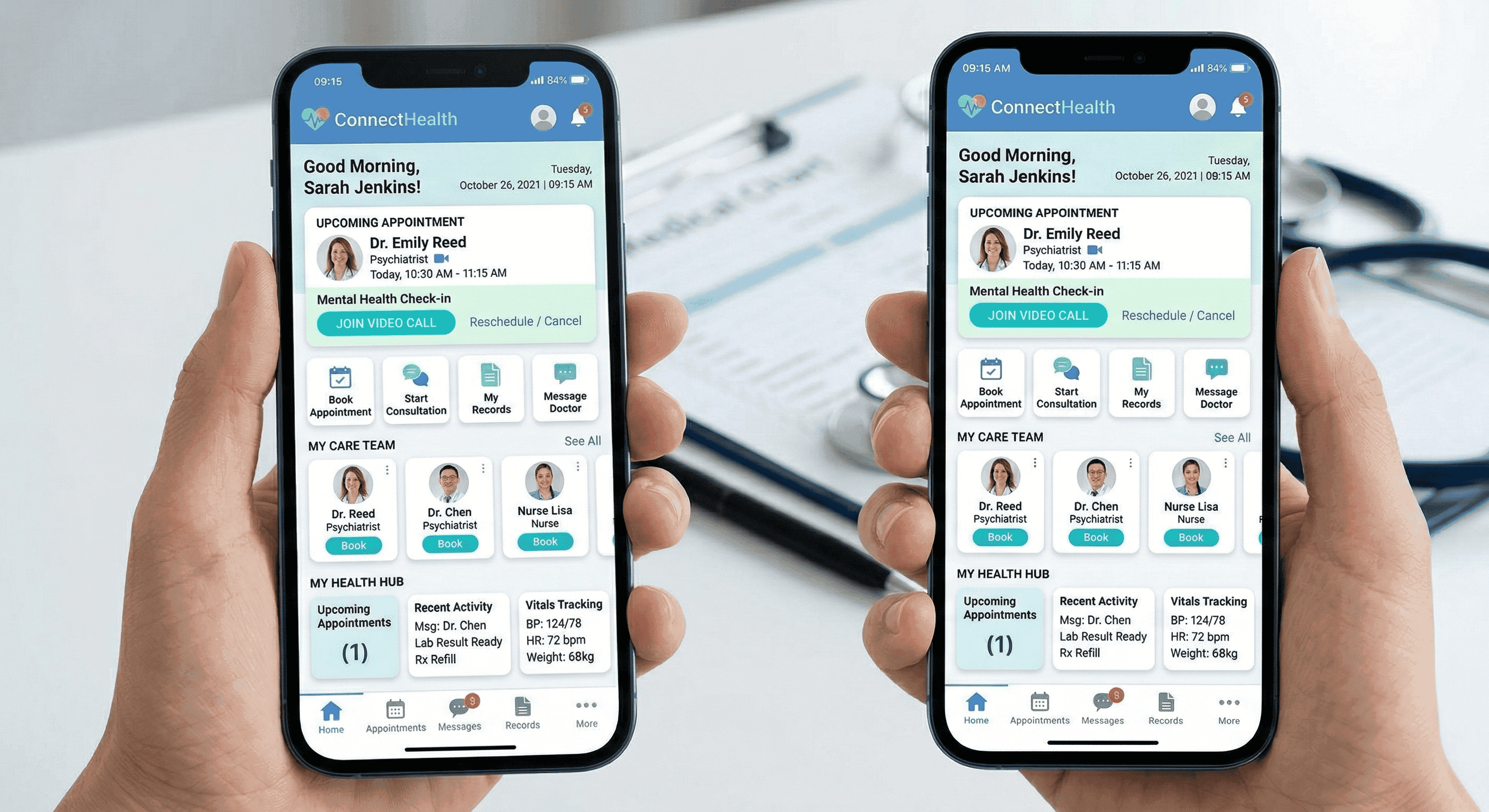
vitals telehealth app
A premium native health network where React powers the management portals and complex provider dashboards with 100% type safety.
Tech Stack Comparisons
Understanding when React is the right choice for your architecture.
| Strategic Feature | Why we use React | Issues with Angular | Issues with Raw JS |
|---|---|---|---|
| Development Velocity | Rapid: Parallel development with reusable components leads to 40% faster average MVP launches. | Moderate: Rigid boilerplate and steep learning curve slow down initial sprint cycles. | Slow: Building state logic from scratch increases development time for every new feature. |
| Maintenance Cost | Low: Declarative state and massive community support minimize long-term technical debt. | High: Frequent major version updates and mandatory RxJS complexity increase upkeep costs. | Extreme: Lack of standardized structure makes scaling and onboarding new devs difficult. |
| UI Consistency | Perfect: Atomic design systems and Storybook integration ensure pixel-perfect brand fidelity. | Complex: Managing shared styles across enterprise modules often leads to UI fragmentation. | Manual: Extremely difficult to enforce strict design standards across large, multi-dev projects. |
| App Performance | Optimized: Advanced memoization allows us to handle 500k+ concurrent real-time data points. | Heavy: Two-way data binding and change detection overhead can cause lag in complex UIs. | Variable: Requires elite, time-consuming manual optimization to maintain frame rates at scale. |
| Strategic Alignment | Ideal: Best for high-growth startups and enterprises needing speed, scale, and agility. | Enterprise Only: Best for extremely rigid, static configurations where speed isn't a priority. | Prototype Only: Best for single-page experiments or extremely simple, static sites. |
Common Questions
Technical and business considerations for React projects.
Is React suitable for SEO-focused websites?
While React is client-side by default, when combined with frameworks like Next.js (which we use for all major projects), it provides world-class SEO performance through server-side rendering.
How does React compare to older technologies like jQuery?
React moves away from direct DOM manipulation in favor of a declarative state-driven approach, making it significantly more efficient and maintainable for modern web applications.
When should we use Redux versus the native React Context API?
We recommend Context API for simpler state like theme or user profiles. For complex, high-frequency state updates or large-scale enterprise applications with complex data flows, we use Redux Toolkit or Zustand for better performance and dev-tooling.
How does SKN IT ensure high performance in React applications?
We implement aggressive code splitting using dynamic imports, utilize React Server Components for heavy logic, and strictly monitor re-renders using the React Profiler. We also enforce code-memoization (useMemo, useCallback) where profiling shows measurable benefits.
Can my React web application be converted to a mobile app?
While the code isn't 1:1, the component-based logic and business logic (hooks, state management) can be shared between React (web) and React Native (mobile), significantly reducing development time for a multi-platform launch.


Have a Project in Mind?
Let's discuss how we can help you achieve your goals. Book a free consultation call with our team and get a no-obligation project estimate within 48 hours.