SME Phishing Prevention & Cyber Training East London | Barking IT
A single rogue click can derail your cash flow. Learn how East London SMEs in Barking, Dagenham, and Ilford can build an ironclad human firewall against phishing scams.

Beyond the Password: How to Train an East London Team to Spot Phishing Scams Before It Costs You Thousands
It is 4:45 PM on a Friday. Your accounts manager at your Dagenham distribution depot or Barking office is rushing through thirty unread emails before shutting down for the weekend. Among them is an urgent message marked “Updated Bank Details for Outstanding Plant Hire Invoice” carrying the exact branding, tone, and email signature of a long-standing supplier.
They click the attachment. They enter their Microsoft 365 credentials on what looks like a routine login prompt.
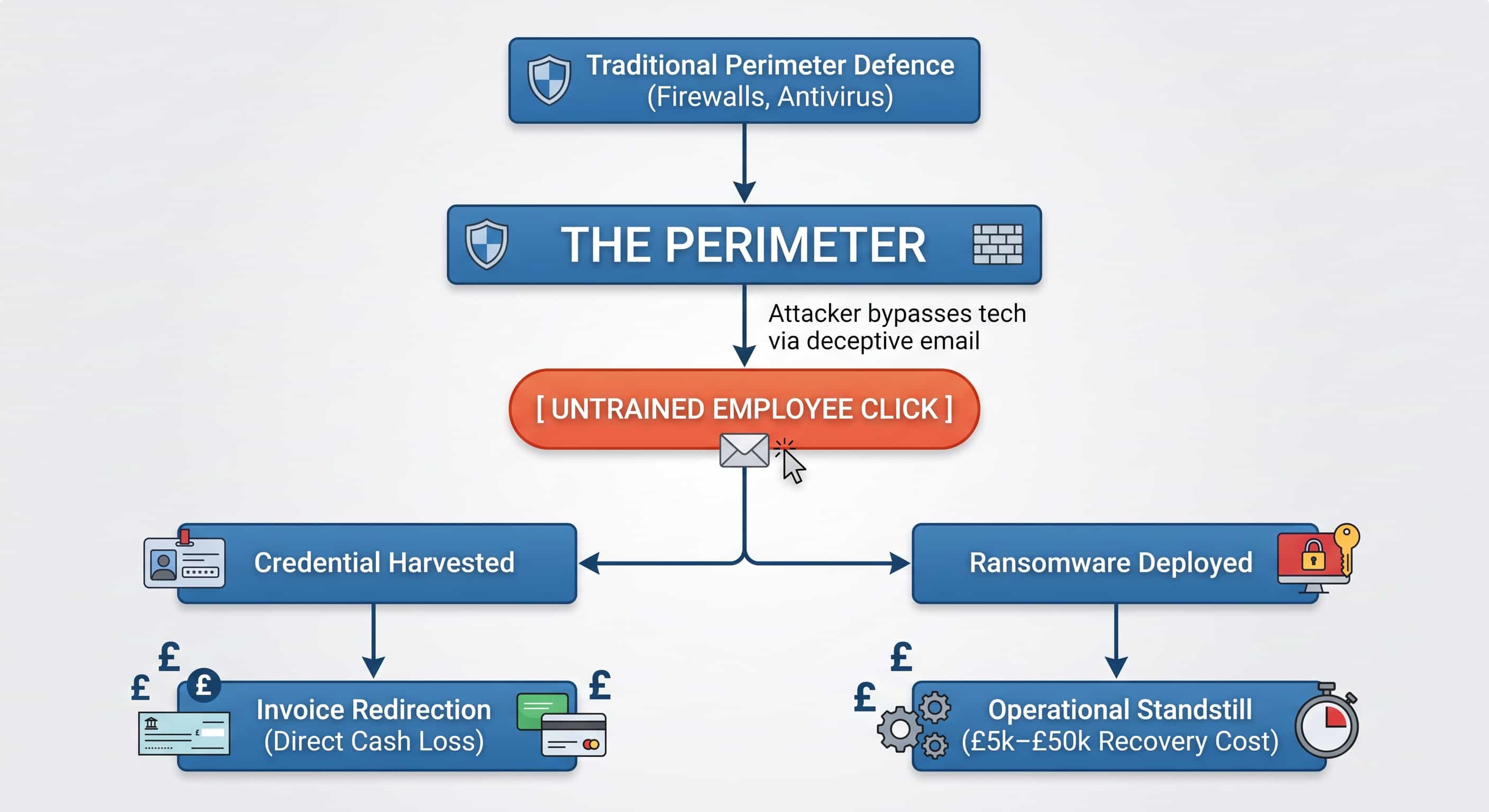
By Monday morning, your supplier hasn't been paid, your business bank account is short £22,000, and malicious actors have spent 48 hours silently mapping your company inbox to target your own clients.
You can spend thousands on enterprise-grade firewalls and premium antivirus software. However, if a stressed, rushed, or untrained employee clicks the wrong link, those perimeter defences are instantly bypassed from the inside.
For growing small-to-mid-sized businesses (SMEs) across Barking, Dagenham, Ilford, and the wider East London corridor, cybersecurity is no longer a back-room IT concern. It is a fundamental cash-flow, operational, and reputational priority.
The Reality of SME Phishing in East London: You Are Not "Too Small to Target"
A dangerous myth persists among local business owners: “Why would international hackers target a 15-person logistics firm in Barking or a construction outfit in Ilford?”
Cybercriminals do not spend weeks trying to break into fortress-like enterprise banks when they can use automated scripts to target hundreds of regional SMEs every single day. Small businesses are targeted precisely because they frequently lack:
Dedicated in-house security teams
Strict dual-control financial processes
Continuous, practical employee security training
The Anatomy of Modern Attacks: What Your Team Is Actually Facing
Modern phishing attacks rarely look like the poorly phrased, generic spam of a decade ago. Attackers leverage AI and publicly available company data to create hyper-targeted campaigns tailored to your specific sector.
Phishing Attack Type | How It Targets East London SMEs | Primary Business Risk |
Business Email Compromise (BEC) | Hackers spoof or compromise an executive’s email address, emailing the accounts team to request an “urgent, confidential supplier payment.” | Immediate, unrecoverable direct cash theft via authorized bank transfer. |
Supply Chain Invoice Fraud | Intercepting legitimate email threads with your subcontractors or logistics partners, then swapping PDF invoice bank details. | Destroyed vendor trust, unpaid bills, and double-payment liabilities. |
Cloud Credential Harvesting | Fake Microsoft 365, DocuSign, or Google Workspace verification prompts designed to capture staff login details. | Total internal system access, customer data theft, and GDPR non-compliance fines. |
HMRC / Regulatory Scams | Phony VAT penalty notices, tax refund claims, or Companies House filing warnings exploiting executive urgency. | Malware deployment and corporate identity theft. |
Why the "Annual 2-Hour Security Presentation" Fails
Most companies tackle security awareness by forcing staff to sit through a dry, tick-box compliance video once a year. By week three, retention drops to near zero.
Phishing attacks prey on human emotion, fatigue, urgency, and authority. When staff are under pressure to hit delivery milestones or clear customer queues, abstract rules about "safe browsing" evaporate.
To build an organization resilient to social engineering, you must replace theoretical lectures with habitual, systemised security reflexes.
The 4-Pillar Human Firewall Framework for Growing Businesses
Transforming your staff from your largest attack surface into your most effective security sensor requires four structural steps:
1. Contextual Micro-Training (3 Minutes Monthly, Not 3 Hours Yearly)
Break training down into bite-sized, contextual challenges delivered directly within the daily workflow. Focus on current real-world examples:
How to inspect an email header rather than trusting the display name.
Identifying subtle domain spoofing (e.g.,
@your-company-ltd.co.ukinstead of@your-company.co.uk).Understanding why legitimate institutions will never ask for credentials via an unauthenticated link.
2. Controlled Phishing Simulations
Run controlled, harmless simulated phishing campaigns tailored to your business sector.
Logistics and trade businesses in Barking Riverside can be tested with simulated courier tracking alerts.
Professional and healthcare practices in Ilford can be tested with mock patient portal or supplier document alerts.
When an employee clicks a simulated link, they aren't reprimanded—they are immediately presented with a 30-second breakdown highlighting the precise red flags they missed.
3. The "Dual-Channel Out-of-Band" Verification Rule
Create an unbendable, company-wide operational policy: No financial detail change or unusual payment request over £500 is ever approved via email alone.
Staff must verify the request via a known, pre-existing secondary channel—such as calling the supplier's verified landline number or speaking directly to the director. This single procedural check halts 95% of Business Email Compromise losses dead in their tracks.
4. Establish a "No-Blame" Reporting Culture
If an employee realizes they clicked a suspicious link, their primary fear shouldn't be disciplinary action—it should be reporting it instantly.
A breach contained within 10 minutes of a click can be isolated by your IT partner before data leaves the network. A breach hidden by a terrified employee for 48 hours can bring down your entire operations.
Layering Technical Safeguards Over Employee Training

Human vigilance must always be reinforced by modern IT infrastructure. While your team acts as your front-line defense, your technology stack must catch the mistakes that inevitably slip through human error.
Managed Multi-Factor Authentication (MFA): Enforcing conditional-access MFA across all cloud accounts ensures that even if an employee surrenders their password, the attacker cannot log in without hardware verification.
Email Authentication Protocols (DMARC, DKIM, SPF): Properly configuring these domain records prevents cybercriminals from sending emails that masquerade as your company domain.
Endpoint Detection & Response (EDR): Deploying intelligent endpoint monitoring isolates any device the moment anomalous scripts or unexpected credential scrapers execute.
A comprehensive defensive posture combines continuous Cyber Security Services with robust Cloud Solutions to guarantee that single points of human failure never escalate into business-ending catastrophes.
Frequently Asked Questions
How often should an SME run staff phishing simulations?
We recommend running randomized, simulated campaigns once every 4 to 6 weeks. Regular cadence ensures high vigilance without creating operational fatigue, gradually reducing click rates from an industry average of 30% down to under 3%.
Is cyber insurance enough to protect our business from financial fraud?
No. Most UK cyber insurers now mandate strict proof of baseline security practices—including active staff security training, operational MFA, and verified payment procedures—before paying out on claims. If a breach occurs due to gross negligence or unverified email redirection, claims can be denied.
How do we balance tight security protocols without slowing down daily operations?
Security should streamline workflows, not stall them. By utilizing automated single sign-on (SSO), secure password vaults, and clear operational verification limits (e.g., checks only required above set financial thresholds), your business stays agile and protected simultaneously.
Protect Your East London Business Before the Next Link Gets Clicked
A comprehensive cyber defense is not built overnight, but closing your biggest vulnerabilities starts with knowing where your business stands today.
We help growing companies across Barking, Dagenham, Ilford, and East London secure their operations, safeguard their cash flow, and turn their teams into proactive defensive assets.
Claim Your Complimentary SME Cyber Vulnerability & Phishing Risk Audit
Let our local technical team assess your email security configuration, test your domain exposure, and provide a clear, jargon-free roadmap to secure your organization.
Book a 15-Minute Strategy Call with Our East London IT Team
Direct Office Line: +44 7428 517262
Visit Our Barking Office: 29A Station Parade, Barking IG11 8EB, United Kingdom